


How to Buy Fresh Peeled Garlic in Bulk?
Buying Fresh Peeled Garlic in bulk looks simple until quality changes from carton to carton. A low price may hide short shelf life, excess moisture, weak packaging, or inconsistent clove sizes. Commercial kitchens, food manufacturers, and distributors need more than attractive photographs. They need a dependable supply, clear specifications, and evidence that the supplier controls each handling stage.
Bill Christopher, a longtime garlic industry leader, captures the principle well: “Quality begins with the bulb, not the package.” The remark matters because peeling cannot repair soft cloves, mold damage, or poor harvesting conditions. Good Fresh Peeled Garlic should have a clean aroma, firm texture, pale color, and minimal surface moisture. It should arrive cold, with a visible packing date and practical use-by guidance. Nearly perfect products are not always necessary. Consistency is often more valuable.
Ask where the bulbs were grown and processed. Request a recent sample before placing a large order. Check clove size, trim loss, odor, liquid inside the bag, and performance after opening. Also review sanitation procedures, cold-chain records, packaging options, and replacement policies. These details reveal operational reliability better than a sales promise.
Some buyers focus too heavily on price. That can be a costly mistake. A cheaper case may create more labor, waste, and production delays. Still, premium pricing alone proves nothing. Compare usable yield, delivery accuracy, storage life, and supplier communication. The right purchase balances freshness, safety, volume, and realistic kitchen needs. Fresh peeled garlic should make production easier, not create another problem to manage.
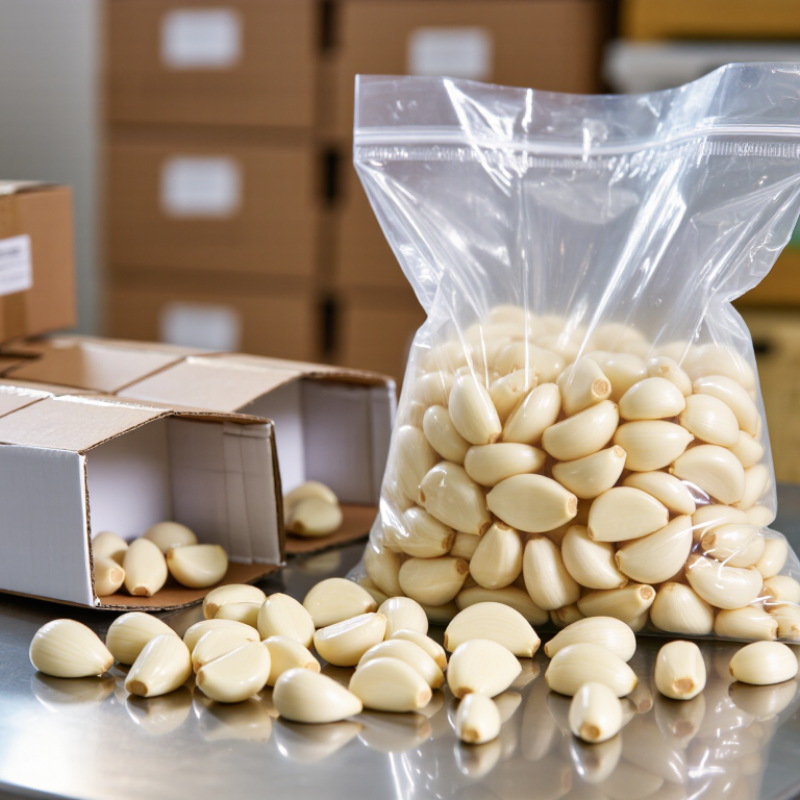
Define Your Bulk Fresh Peeled Garlic Requirements
Before requesting a quotation, define your fresh peeled garlic requirements precisely. FAOSTAT production data place global garlic output above 28 million metric tonnes annually, but supply consistency still varies by harvest, region, and storage conditions. State your monthly volume, delivery frequency, preferred clove size, and acceptable percentage of broken pieces. Specify whether you need whole cloves, sliced garlic, or minced garlic. These details prevent a low price from hiding unsuitable yield.
Freshness needs measurable language. Request the peeling date, harvest season, storage temperature, and remaining shelf life at delivery. A practical specification may include clean, firm cloves, no visible mold, no sour odor, and minimal bruising. Ask for microbial testing and batch traceability. USDA Agricultural Marketing Service grading guidance emphasizes size, defects, and condition for garlic; peeled garlic needs additional handling controls. The standard is useful, but not complete.
Tips: Calculate usable garlic, not gross weight. Weigh one delivered carton after trimming and drainage. Then compare actual yield with your production forecast. Confirm packaging size, carton dimensions, pallet limits, and refrigerated transport before ordering. Leave a small tolerance for seasonal variation. I once treated “fresh” as a sufficient specification; it was not. A clear acceptance sample, agreed before shipment, can expose problems early. Short test orders are often wiser than immediate full-volume commitments.
| Requirement Dimension | Recommended Bulk Specification | Practical Target or Acceptable Range | How to Verify Before Purchase | Priority |
|---|---|---|---|---|
| Product Type | Fresh, peeled garlic cloves made from mature bulbs; not dehydrated, canned, pickled, or previously frozen. | Fresh peeled cloves with a natural cream to pale-yellow color. | Review the product specification, production date, ingredient declaration, and sample appearance. | High |
| Intended Use | Define whether the garlic will be used for foodservice, sauces, ready meals, processing, retail repacking, or industrial production. | One clearly defined end use for each order or delivery program. | Match the required cut, pack size, shelf life, and food-safety documents to the application. | High |
| Order Quantity | Specify the required quantity per shipment and the expected purchasing frequency. | Common planning units include 5 kg, 10 kg, 20 kg, or 25 kg cartons; confirm the exact pack configuration in advance. | Request a written quotation showing net weight per case, number of cases, pallet quantity, and total shipment weight. | High |
| Clove Size | Choose a size grade that suits the peeling, slicing, mincing, or cooking process. | Uniform medium-to-large cloves are generally easier to handle; define the size by count per kilogram or millimeters where available. | Inspect a representative sample and measure clove size or count the number of cloves per kilogram. | Medium |
| Appearance | Cloves should be whole, firm, clean, and reasonably uniform, without excessive discoloration or dehydration. | No visible mold, black rot, severe bruising, sprouting, or foreign material. | Perform a visual inspection of opened cartons from different pallet positions. | High |
| Texture | Firm and crisp enough for the intended preparation process; avoid soft, watery, slimy, or rubbery cloves. | Limited natural variation is acceptable, but soft or leaking cloves should be rejected according to the agreed tolerance. | Press several cloves from each sample lot and check for excessive softness or liquid release. | High |
| Peeled Condition | Cloves should be substantially free of the outer skin and root plate, with minimal remaining peel. | Define a maximum tolerance for skin fragments and unpeeled cloves before ordering. | Count remaining skin fragments or unpeeled cloves in a defined sample, such as 1 kg. | High |
| Defect Tolerance | Set separate tolerances for mold, decay, sprouting, severe damage, discoloration, and foreign matter. | Zero tolerance for visible mold, decay, and foreign material is commonly used for fresh ready-to-use garlic. | Use an agreed inspection method and record the percentage of defective cloves by weight or count. | High |
| Odor and Flavor | Normal fresh garlic aroma and flavor without sour, fermented, chemical, musty, or rotten odors. | Clean garlic aroma with no off-odor after opening the package. | Inspect the product immediately after opening and compare it with the approved reference sample. | High |
| Moisture and Drainage | Product should not be excessively wet or surrounded by free liquid inside the package. | Set a buyer-specific moisture or drainage limit where texture and shelf life are critical. | Check package bottoms, weigh drained product if applicable, and inspect for condensation or leakage. | Medium |
| Microbiological Safety | Require testing and controls appropriate for a ready-to-use fresh agricultural product. | Agree on applicable limits for pathogens, indicator organisms, and yeasts and molds according to the destination market and use. | Request a recent certificate of analysis and the supplier's sampling and testing procedure. | High |
| Pesticide Compliance | Residues must comply with the legal maximum residue limits of the destination country. | Use a current multi-residue test report from an appropriately qualified laboratory when required. | Confirm the test date, laboratory details, tested compounds, and destination-market requirements. | High |
| Food-Safety Program | Supplier should operate documented hygiene, traceability, sanitation, and hazard-control procedures. | Accept recognized third-party certification or equivalent documented food-safety controls, depending on purchasing policy. | Review certificates, audit summaries, sanitation procedures, and corrective-action records where applicable. | High |
| Packaging Material | Use clean, food-contact-safe packaging that protects the cloves from contamination, crushing, and moisture loss. | Typical formats include sealed food-grade bags, vacuum packs, or lined cartons with a defined net weight. | Confirm packaging material declarations, seal integrity, carton strength, and suitability for chilled transport. | High |
| Modified Atmosphere or Vacuum | Specify whether vacuum or modified-atmosphere packaging is required for the distribution period. | Use only when the packaging method has been validated for the product and storage conditions. | Check the package seal, gas or vacuum specification, swelling, leakage, and temperature history. | Medium |
| Net Weight | Define whether pricing is based on net product weight or gross shipment weight. | Each case should show net weight, lot code, packing date, and storage instructions. | Randomly weigh sealed cases and compare net contents with the declared quantity. | High |
| Temperature at Receipt | Maintain a continuous chilled cold chain from packing through delivery. | A commonly used receiving target for fresh peeled garlic is 0–4°C, unless the validated product specification states otherwise. | Measure the product or package temperature at receiving and review temperature-monitoring records. | High |
| Storage Conditions | Store unopened product under refrigeration in a clean area away from raw materials that may cause cross-contamination. | Keep within the supplier's validated temperature range; avoid freezing unless the product is specifically sold as frozen. | Confirm warehouse temperature logs, pallet airflow, stock rotation, and separation practices. | High |
| Shelf Life | Specify the required remaining shelf life at delivery rather than only the total shelf life after packing. | Fresh peeled garlic often has a short refrigerated shelf life; require the supplier to state a validated period and minimum remaining days at receipt. | Compare the packing date, use-by date, transport time, and receiving date on every lot. | High |
| Date Coding | Every case and inner package should carry readable traceability information. | Include product name, lot code, packing date, use-by date, net weight, storage temperature, and country of origin where required. | Check labels during receiving and confirm that the lot code links to production and testing records. | High |
| Transport Plan | Use refrigerated transport with protection from temperature fluctuations, crushing, and direct sunlight. | Agree on delivery schedule, maximum transit time, pallet configuration, and temperature-recording method. | Review the bill of lading, temperature log, delivery time, and condition of pallets and cartons. | High |
| Origin and Traceability | Record the country or region of origin and maintain one-step-back and one-step-forward traceability. | Each lot should be traceable to the farm, packing facility, packing date, and shipment documentation where applicable. | Request traceability records and conduct a document-based mock recall if required by company policy. | High |
| Order Flexibility | Define minimum order quantity, split-delivery options, lead time, and emergency replenishment capability. | Choose order intervals that match actual consumption so the product can be used before its validated use-by date. | Compare forecasted weekly usage with case quantity, delivery frequency, and storage capacity. | Medium |
| Acceptance and Claims | Agree on inspection timing, evidence requirements, rejection criteria, and credit or replacement procedures. | Document claims with photographs, temperature readings, lot codes, weights, and defect percentages. | Include the acceptance standard in the purchase order or supply agreement before the first shipment. | High |
| Sample Approval | Approve a representative pre-shipment sample before committing to recurring bulk deliveries. | Evaluate appearance, odor, texture, peel cleanliness, packaging, cooking performance, and chilled holding behavior. | Retain an approved reference sample or written specification for comparison with future lots. | High |