How to Choose Strawberry Flavor Extract for Your Business?
Choosing the right strawberry flavor extract can shape how customers remember your product. The decision is not simply about finding the strongest berry aroma. It involves taste, stability, labeling, cost, and how the extract behaves in a real recipe.
Gary Reineccius, a respected flavor chemist and author of Flavor Chemistry and Technology, offers a practical reminder: “Test the flavor in the finished product, not only in the bottle.” His point matters. A sample may smell bright on a paper strip, then fade in yogurt, turn sharp in a beverage, or lose its character during baking. Small differences become obvious.
Start with the product itself. A strawberry flavor extract for syrup may need high water compatibility. A baked filling may require heat stability. Milk-based products can soften acidity and change the perceived sweetness. Check the recommended dosage, carrier, solubility, allergen statement, shelf life, and certificate of analysis. Ask whether the profile is natural, nature-identical, or artificial, then confirm the labeling requirements in your target market. Suppliers should provide consistent batch data and clear technical support.
Taste tests should use your actual formula. Not a perfect laboratory drink. Use the same cup, temperature, serving size, and storage time. Compare several samples beside real strawberries. The cheapest option may look attractive. It may also demand more dosage or create an uneven aftertaste. I would not ignore that risk. A slightly imperfect first trial often reveals more than a polished supplier presentation. The best choice balances authentic aroma, reliable performance, customer expectations, and commercial practicality.
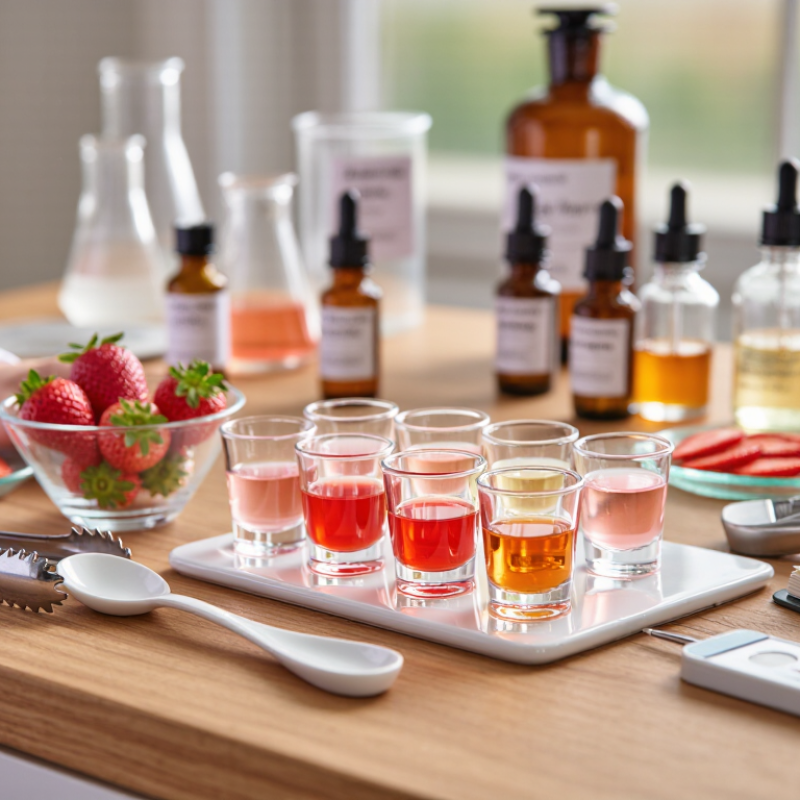
Map Strawberry Aroma Chemistry: Furaneol, Esters, and Terpenes
How to Choose Strawberry Flavor Extract for Your Business?
Strawberry aroma is not one simple note. A Journal of Agricultural and Food Chemistry review reports more than 360 volatile compounds in strawberries. Only a smaller group strongly shapes consumer perception. Furaneol gives ripe fruit, caramel, and jam-like warmth. Its effect is powerful at low levels. Too much can taste burnt or overly sweet.
Esters create the familiar fresh-fruit lift. Ethyl butyrate can suggest pineapple, while methyl butyrate adds bright, sweet fruitiness. Terpenes contribute green, floral, and sometimes citrus-like accents. Linalool may soften a formula, but excessive terpene character can feel herbal. In practical bench testing, aroma changes after heating, dilution, and storage. That part is often underestimated. A flavor can smell excellent in the bottle, then fade in yogurt or baked fillings.
Tips: Ask suppliers for GC-MS data, allergen documentation, and stability results. Compare samples at the same dosage, temperature, and pH. Use a blind sensory panel when possible. Check furaneol, ester, and terpene balance rather than chasing maximum intensity. FEMA’s flavor ingredient resources and IFRA safety guidance can support responsible screening. These sources help, but they do not replace product-specific testing. One weakness remains: published aroma data often comes from fresh fruit, not finished foods. Your matrix may tell a different story.
Classify Flavor Claims Under U.S. 21 CFR 101.22 and EU 1334/2008
How to Choose Strawberry Flavor Extract for Your Business?
A strawberry flavor extract should match its legal claim before it matches your product brief. In the United States, 21 CFR 101.22 distinguishes natural flavor, artificial flavor, and flavor declarations. A formula using strawberry-derived flavoring may support “natural strawberry flavor” only when its composition and source meet the applicable requirements. If synthetic components create the characteristic taste, “artificial flavor” may be required. The wording “strawberry flavored” can also create consumer expectations, so review the entire label, not one phrase.
The European Union applies Regulation (EC) No 1334/2008, with stricter source-based language. “Natural strawberry flavouring” generally requires at least 95% of the flavoring component to come from strawberries. The remaining portion may refine the profile, but it cannot replace the main source.
“Natural flavouring” is broader and does not name strawberry as the exclusive source. A supplier specification should show raw material origins, carrier ingredients, production methods, and supporting analytical records. Ask for the documentation before approving samples.
I have seen teams choose a bright, realistic extract first, then discover that the intended claim does not fit the formula. That mistake is avoidable, but specifications can still be incomplete. Check the finished product, dosage, processing conditions, and local market separately. Claims may change after baking, storage, or blending. Regulatory review should confirm the final label in each target country.
Stay cautious.
Match Extract Stability to Product pH, Heat, and Shelf-Life Data
How to Choose Strawberry Flavor Extract for Your Business?
Match Extract Stability to Product pH, Heat, and Shelf-Life Data
A strawberry extract should fit the product environment, not just smell attractive in a sample bottle. Measure the finished product’s pH, processing temperature, oxygen exposure, and storage period before choosing an extract. Low-pH drinks can sharpen strawberry notes, but they may also reduce freshness over time. Request stability data under similar conditions.
Heat changes the decision. A bakery filling may face 80–95°C during processing, while a chilled beverage may avoid severe heating. Volatile strawberry compounds can fade during baking or pasteurization. For heated products, compare samples before and after processing. Check aroma strength, color, acidity, and aftertaste. Small bench trials often reveal more than a supplier’s general specification.
Shelf-life testing needs realistic packaging and storage. Use clear and opaque containers when light sensitivity matters. Test at refrigerated, room, and accelerated temperatures, while recording sensory changes weekly. A stable extract can still perform poorly when acidity, sugar, or minerals alter its profile. I have seen teams approve a flavor after one fresh tasting, then discover a thin, jam-like note after six weeks. That shortcut is tempting. It is also unreliable. Keep a control sample, repeat the test, and involve trained tasters alongside laboratory measurements.
How to Choose Strawberry Flavor Extract for Your Business?
Match extract stability to product pH, heat exposure, and intended shelf life. The chart compares representative thermal conditions commonly encountered in different food applications.
| Product Application |
Typical pH |
Representative Heat Exposure |
Typical Target Shelf Life |
Selection Direction |
| Acidified Beverage |
2.8–3.5 |
Hot-fill around 85°C |
Up to 12 months |
Prioritize acid and heat stability |
| Pasteurized Dairy Product |
6.2–6.8 |
Pasteurization around 72°C |
Up to 6 months |
Check compatibility with proteins and fat |
| Baked Filling or Bakery Product |
6.0–7.5 |
Oven temperatures around 180°C |
Up to 9 months |
Use a heat-resistant system and validate after baking |
| Cooked Confectionery |
3.0–6.0 |
Cooking around 120°C |
Up to 18 months |
Prioritize heat, oxidation, and long-term storage stability |
These are representative formulation and process ranges rather than universal specifications. Final selection should be confirmed through pilot trials, accelerated stability testing, packaging evaluation, and sensory checks at the intended pH, process temperature, and storage period.