

China has become a major sourcing center for seasoning products, including Chicken Seasoning Cubes. However, identifying the “top” suppliers requires more than comparing online prices. Production scale, ingredient transparency, export experience, and quality controls all deserve careful review.
This guide examines Chinese manufacturers that serve wholesalers, food brands, and international distributors. It considers factory capabilities, private-label services, packaging options, minimum order quantities, and communication standards. Reliable suppliers should explain their formulations clearly and provide practical documents, such as product specifications, certificates, batch records, and testing reports. Details matter. A cube that dissolves evenly in hot soup may perform very differently in fried rice or marinades.
Taste consistency is another important measure. Professional buyers may request samples from different batches before approving a long-term order. They should also check salt levels, aroma strength, color, moisture resistance, and packaging durability. A supplier may look impressive online but still lack stable quality control. That gap is easy to miss.
Not every large factory is the best fit. Some smaller producers offer faster customization, while larger companies may provide stronger capacity and export support. This comparison focuses on evidence rather than promotional claims. Supplier rankings can also change as certifications, equipment, and customer feedback develop. That limitation deserves attention.
The following sections introduce notable Chinese suppliers and explain what makes each one competitive. They also highlight potential weaknesses, helping buyers make a more informed and realistic sourcing decision.
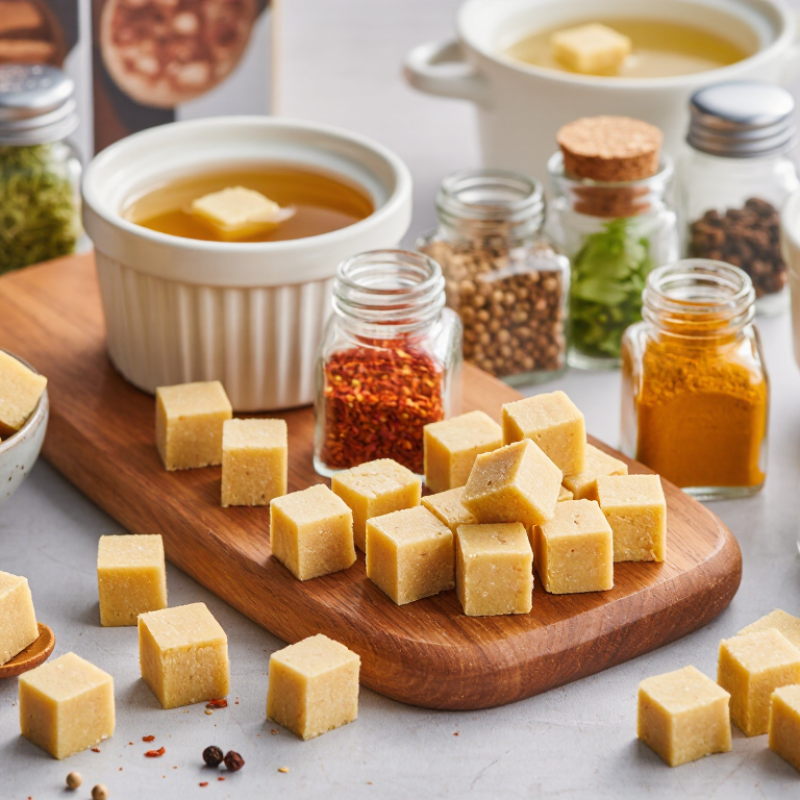
China’s chicken seasoning cube industry expanded in 2024, supported by instant meals, household cooking, restaurants, and export demand. Market size estimates vary widely. Definitions differ between retail cubes, catering packs, and private-label production. This makes one precise figure unreliable. A practical reading suggests steady growth, with stronger momentum in lower-tier cities and food-service channels.
Top suppliers usually fall into three groups: large seasoning manufacturers, regional food factories, and OEM or ODM processors. The strongest suppliers typically offer stable chicken flavor, controlled salt levels, moisture-resistant packaging, and flexible order quantities. Many also support formula adjustment for local tastes. Buyers should inspect production licenses, laboratory records, allergen controls, and batch traceability before comparing prices.
Small details matter. A good cube dissolves quickly in hot broth. It should not leave excessive oil on the surface. Packaging must survive humid warehouses and long-distance transport. Factory audits remain valuable, especially for export orders. Yet supplier rankings are not fully transparent. Some companies report revenue, while others disclose only production capacity. That weakens direct comparisons. Growth forecasts can also look too optimistic when short-term promotions inflate sales. Careful buyers should request recent samples, independent test reports, and repeat-order performance before making a final decision.
China’s top chicken seasoning cube suppliers should be ranked by three measurable indicators: revenue, production output, and export volume. Public company filings, China Customs data, and audited factory disclosures provide the strongest evidence. However, no official database isolates chicken cubes perfectly. UN Comtrade’s HS 210390 category is a useful export proxy, but it also includes other mixed condiments.
Revenue leaders usually operate large seasoning plants and serve restaurants, wholesalers, and overseas distributors. Output leaders show stronger factory capacity, automated pressing lines, and stable raw-material purchasing. Export leaders deserve separate attention. China Customs statistics can reveal shipment value, destination markets, and annual growth. The China Condiment Industry Association also tracks broader sauce and seasoning trends, helping buyers compare domestic demand with international movement. These reports suggest that scale matters, but it does not prove better flavor or consistency.
The ranking should combine audited revenue, verified annual output, and three-year export volume. Avoid rankings based only on website claims. Some suppliers publish capacity, not actual production. That difference matters.
Tips: Ask for recent customs records, HACCP or ISO documentation, batch testing, and factory audit results. Request samples from different production lots. One shipment can look perfect.
A practical shortlist places high-revenue manufacturers first, high-output factories second, and export-specialist suppliers third. This method is less glamorous, but more defensible. Data gaps remain. That should be stated clearly.
Leading suppliers are usually large food manufacturers with multiple automated production lines. Their capacity may range from several tons to hundreds of tons daily. However, stated output needs careful verification. A large factory does not always deliver consistent flavor.
Strong suppliers normally hold HACCP and ISO 22000 systems. Some also maintain BRCGS, Halal, or Kosher certifications. Buyers should check certificate numbers, issuing bodies, and expiration dates. Site audits can reveal more than documents. Inspect raw material storage, allergen controls, laboratory testing, and packaging hygiene. Small details matter.
Product portfolios often include standard chicken cubes, low-sodium formulas, spicy versions, and vegetable-enhanced blends. Some manufacturers provide customized recipes, private packaging, and different cube weights. Export-ready suppliers usually support moisture-resistant foil, retail cartons, and bulk foodservice packs. Ask for batch samples and test them in real cooking conditions. Broth clarity, aroma, salt balance, and cube stability can change after storage. This is often overlooked. Supplier comparisons should also examine traceability, lead times, minimum order quantities, and backup production plans. Capacity claims may sound impressive, yet delayed shipments remain a practical weakness.
China’s chicken seasoning cube suppliers differ sharply in MOQ, recipe control, packaging, and delivery speed. MarketsandMarkets estimated the global spices and seasonings market at about USD 27 billion in 2024. Demand is moving toward convenient, portion-controlled formats. That trend supports OEM development, but market estimates vary by product definition.
MOQ is often the first negotiation point. Many factories quote 5,000–20,000 boxes for standard recipes. Custom sodium levels, halal requirements, or allergen controls can raise the minimum. A practical buyer should request pilot production before committing. Small trials expose flavor imbalance, powder separation, or weak cube structure. I learned that samples can taste excellent, yet fail during humid storage.
Formulation ownership matters. Ask for ingredient percentages, stability records, and batch-testing procedures. Packaging options usually include laminated sachets, printed cartons, and moisture-resistant inner film. Packaging design can add seven to fifteen days when cylinders or plates require approval. According to Smithers’ packaging industry analysis, flexible packaging continues gaining share because of lightweight logistics and barrier performance. Standard OEM lead times commonly range from 25 to 45 days after artwork approval. Custom formulas may require 45 to 75 days. These figures are not universal. Port congestion, ingredient shortages, and repeated sample revisions can extend schedules. A reliable supplier should provide a written timeline, retention samples, and clear change-control terms.
The comparison below uses anonymized Chinese OEM supplier profiles and practical industry benchmark ranges for chicken seasoning cubes. Final specifications, prices, certifications, and production schedules should be confirmed through a written quotation and sample approval.
| Supplier Profile | Typical OEM MOQ | Product Format | Formulation Options | Common Cube Weight | Packaging Options | Private-Label Capability | Estimated Lead Time | Quality and Compliance Documentation | Best Fit |
|---|---|---|---|---|---|---|---|---|---|
| Profile A Large-Scale Export Factory | 1,000–2,000 kg per formula | Compressed seasoning cubes; individually wrapped or bulk-packed |
| 4 g, 8 g, or 10 g | Aluminium foil wrap, printed OPP film, inner carton, export carton, or shrink-wrapped bulk packs | Yes; custom artwork, carton size, language, and ingredient declaration | 25–40 business days after artwork, deposit, and formula approval | HACCP or ISO 22000 system commonly available; batch COA and microbiological test reports available upon request | Supermarket programs, distributors, and large import orders |
| Profile B Mid-Sized Flexible OEM Factory | 500–1,000 kg per formula | Pressed cubes, granules, and powdered chicken seasoning |
| 4 g, 5 g, 10 g, or customized | Printed foil, plain foil with sticker, sachet bundles, plastic jars, or laminated pouches | Yes; lower-volume artwork support may be available | 20–35 business days for existing formulas; 30–45 business days for new formulas | Product specification sheet, allergen statement, COA, and shelf-life data typically available | Importers testing new markets and regional food-service distributors |
| Profile C Small-Batch Custom Formulator | 300–500 kg per formula | Custom compressed cubes and trial-size seasoning formats |
| 4 g, 5 g, or 8 g | Plain foil, stock packaging with labels, custom printed film, and small retail cartons | Yes; suitable for limited-edition or test-market packaging | 15–30 business days for stock materials; 30–50 business days with new packaging | Ingredient list, nutrition information, sample COA, and third-party testing can generally be arranged | Startups, online food brands, and buyers validating a new recipe |
| Profile D Food-Service Focused Manufacturer | 1,000–3,000 kg per order | Larger compressed cubes, catering packs, and bulk seasoning blocks |
| 8 g, 10 g, 20 g, or bulk format | Bulk bags, food-service cartons, multi-pack inner boxes, or individually wrapped cubes | Yes; custom outer cartons and case configurations | 20–35 business days for repeat products; 35–50 business days for new specifications | Batch traceability, COA, shelf-life statement, and export documentation commonly available | Restaurants, catering companies, wholesalers, and institutional kitchens |
| Profile E Premium Natural-Ingredient Manufacturer | 500–1,500 kg per formula | Premium compressed cubes and clean-label powdered seasoning |
| 4 g, 5 g, or 10 g | Printed foil, recyclable laminate options, paper cartons, and premium gift or retail boxes | Yes; premium artwork and multilingual packaging support | 30–50 business days, depending on ingredient sourcing and packaging approval | Ingredient traceability, allergen control, COA, nutrition analysis, and third-party testing may be provided | Premium retail products and health-oriented food channels |
| Profile F High-Volume Cost-Optimized Factory | 2,000–5,000 kg per formula | Standard compressed cubes and high-volume bulk seasoning |
| 4 g, 8 g, or 10 g | Economical foil wrap, bulk cartons, palletized export cartons, and standard retail multipacks | Yes; most suitable for established artwork and repeat packaging | 18–30 business days after confirmation of specifications and packaging materials | Standard COA, batch records, product specification, and export packing documentation generally available | High-volume importers seeking consistent unit costs |
When evaluating chicken seasoning cube suppliers in China, quality verification should begin with GB 2760 compliance. This standard controls permitted food additives and their use limits. Ask suppliers for a formula-based review, not a generic certificate. Each ingredient should match the declared recipe, dosage, and product category.
HACCP shows how hazards are identified and controlled during production. ISO 22000 adds a broader food safety management framework. Still, certificates alone prove little. Check the issuing body, validity period, production site, and audit scope. Request a recent COA for each batch. It should cover moisture, microbiological results, salt content, and other agreed specifications. A polished document is not enough.
Traceability must work beyond paperwork. Test whether one lot code can reveal raw materials, processing dates, operators, packaging records, and shipment details. During supplier visits, inspect sealed seasoning rooms, allergen controls, and storage temperatures. In practice, records may contain gaps or inconsistent dates. That is worth questioning. Independent laboratory testing can confirm key COA results before purchase. Retain samples from delivered batches for comparison. Supplier approval should remain active, with periodic reviews rather than a single inspection.
This chart summarizes the number of core verification points used when screening suppliers without presenting company or brand data. HACCP is assessed against its seven principles, ISO 22000:2018 against clauses 4–10, and traceability against one-step-back and one-step-forward controls.
GB 2760 review points cover additive identity, permitted food category, and maximum use level. COA review points cover product identity, lot information, test results, and specification compliance. These are verification checkpoints, not supplier scores or certification counts.